
Introduction
Tomorrowland and Burning Man represent two paradigms within the global festival landscape, each encapsulating distinct philosophies, artistic expressions, and sociocultural frameworks. While Tomorrowland is rooted in the highly curated world of electronic dance music (EDM) and commercial festival production, Burning Man functions as an experimental, participatory art event emphasizing radical self-expression and communal living. This comparative analysis explores the defining characteristics of these festivals, examining their spatial configurations, audience demographics, artistic frameworks, and cultural implications.
Spatial Configurations and Environmental Context
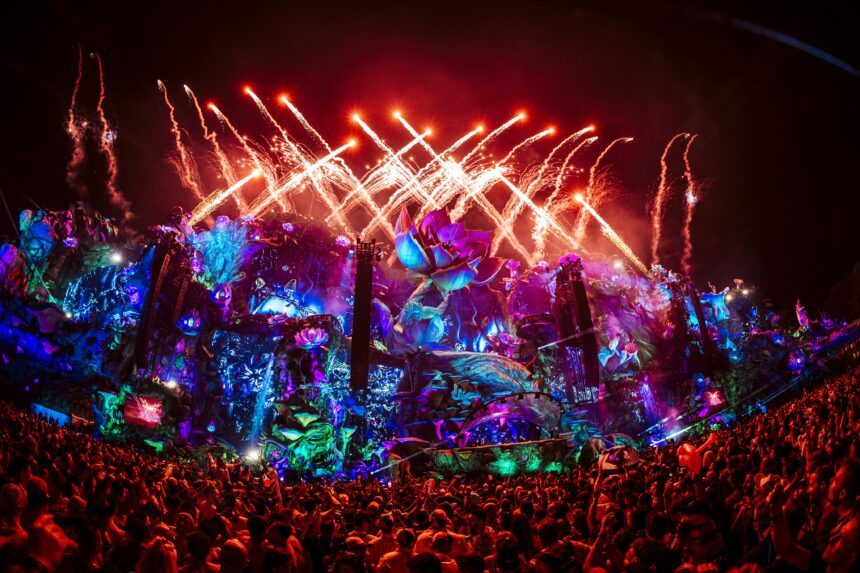
- Tomorrowland: Situated in Boom, Belgium, Tomorrowland unfolds within a controlled, meticulously designed environment. The festival is renowned for its elaborate stage architecture, immersive set designs, and high-production audiovisual displays that create an escapist fantasy world. The integration of natural landscapes with fabricated thematic elements reinforces a sense of immersion, shaping an experience that is both theatrical and meticulously orchestrated.
- Burning Man: Conversely, Burning Man is held in the Black Rock Desert of Nevada, a location that necessitates self-sufficiency due to its extreme climate and isolation. Unlike the structured spatial organization of Tomorrowland, Burning Man operates on a temporary urban model known as Black Rock City, which is governed by principles of communal effort and self-reliance. The radial city layout fosters a decentralized, non-hierarchical mode of interaction that contrasts with the heavily coordinated nature of commercial music festivals.
Artistic and Musical Frameworks
- Tomorrowland: As one of the most significant global EDM festivals, Tomorrowland features an elite lineup of international DJs, producers, and electronic musicians. The festival’s thematic approach—integrating music with elaborate storytelling, pyrotechnics, and synchronized performances—positions it as a sensory spectacle, emphasizing aesthetic uniformity and curated artistic direction.
- Burning Man: In stark contrast, Burning Man does not adhere to a predefined artistic or musical structure. There is no central lineup or headlining performances; instead, music emerges organically through community-generated art installations, sound camps, and mobile performance spaces. The absence of commercial sponsorships or external branding enables a participatory artistic model where attendees contribute to the sonic and visual landscape.
Sociocultural Dynamics and Community Engagement
- Tomorrowland: The festival attracts a cosmopolitan audience with a shared affinity for electronic music culture. While it fosters a sense of collective euphoria through shared musical experiences, its commercial framework dictates a structured form of participation. Attendees consume rather than contribute to the artistic process, engaging within predefined entertainment spaces.
- Burning Man: The ethos of Burning Man is rooted in co-creation, gifting, and radical inclusion. Unlike Tomorrowland, which follows a producer-consumer model, Burning Man mandates active engagement from its participants. The culture of gifting (as opposed to transactional exchange) reinforces a decommodified environment where artistic contributions and community-driven experiences take precedence over passive entertainment consumption.
Economic and Logistical Considerations
- Tomorrowland: Tickets for Tomorrowland are highly sought after and sell out rapidly. Attendees must navigate a competitive purchasing system and, in many cases, invest in travel packages that include accommodations and transport logistics. The festival’s integration with global tourism networks further solidifies its position as a commercialized entertainment event.
- Burning Man: While ticketing for Burning Man also follows a tiered and highly competitive model, participation requires additional logistical considerations. Attendees must arrange for their own sustenance, shelter, and survival gear due to the desert’s inhospitable conditions. The economic structure of Burning Man operates outside conventional market systems, relying on self-sufficiency and non-monetary exchanges within the event itself.
Conclusion
Tomorrowland and Burning Man, while both globally renowned, epitomize contrasting paradigms in festival culture. Tomorrowland functions as a spectacle-driven, commercially produced EDM experience, emphasizing aesthetic grandeur and structured entertainment. Burning Man, on the other hand, is a radically participatory, non-commercial experiment in artistic self-expression and communal living. The choice between the two is contingent on an individual’s preference for either a curated, immersive festival or an open-ended, co-created cultural phenomenon. In a broader cultural discourse, these events exemplify the evolving dynamics of modern festival culture, challenging the boundaries between entertainment, art, and social engagement.